
Grace and peace to you from God our Father and our Lord and Savior Jesus Christ. Amen.
As some of you know I love music. It is at the foundation of a lot of things I have done in my life. I love finding new artists that speak to me. I love listening to the classics that we markers of highlights and lowlights in my life.
This weekend thousands are in Minneapolis celebrating and remembering the life of Prince.
This week marks the tenth anniversary of Prince's death.
Throughout this service you may have noticed little references to his music woven into our worship.
That's intentional.
Not because Prince was perfect.
Not because musicians should become our theologians.
But because Prince spent much of his life wrestling with the same questions that Scripture wrestles with:
What does it mean to be human?
What do we do with our failures?
Where do we find hope?
And where is God in the middle of it all?
One of Prince's lesser-known songs is called The Cross.
You will hear it during our sharing of communion.
It begins in darkness.
A black day.
A stormy night.
No love.
No hope in sight.
It's a song about a broken world and broken people.
But then Prince repeats a simple phrase:
"Don't cry, He is coming."
As I reflected on today's readings, another phrase came to mind.
A phrase that may summarize the message of all three readings:
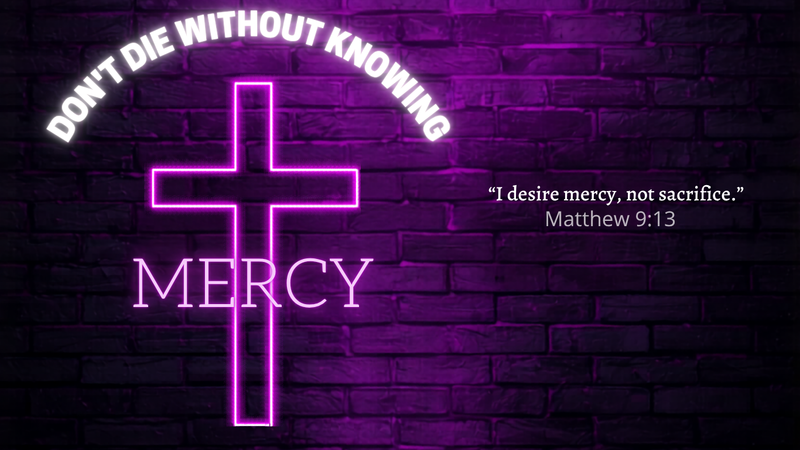
Don't die without knowing mercy.
Because mercy changes everything.
In today's Gospel, Jesus walks past a tax collector's booth.
Matthew is sitting there.
Now tax collectors were not respected people.
They worked for the occupying Roman government.
Many became wealthy by exploiting their neighbors.
They were considered sinners before Jesus ever met them.
If anyone should have needed to get their life together before coming to God, it was Matthew.
But Jesus doesn't begin with judgment a lecture or a list of requirements for membership to be a Christian.
Jesus simply says:
"Follow me."
And Matthew gets up and follows.
The religious leaders can't believe it.
Why is Jesus eating with tax collectors and sinners?
Why is he spending time with people who don't deserve it?
And Jesus answers with words that cut right to the heart of the Gospel:
"I desire mercy, not sacrifice."
Mercy. Not proving yourself.
Mercy. Not religious performance.
Mercy. Not earning your way into God's favor.
Mercy.
And if we're honest, many of us still struggle with that.
We live in a world that runs on performance.
We earn grades.
We earn promotions.
We earn respect.
We earn approval.
Everything feels conditional.
Everything feels transactional.
And sometimes we imagine God works the same way.
If I'm good enough.
If I pray enough.
If I serve enough.
If I fix enough of my mistakes.
Then maybe God will love me.
But that's not the Gospel.
The Gospel is that Jesus calls Matthew before Matthew has fixed anything.
The invitation comes before the transformation.
Mercy comes first.
That same truth echoes through Hosea.
God is speaking to people who have wandered away.
Their faithfulness disappears like the morning dew.
Yet God does not abandon them.
God continues calling them back. Again and again.
Because God's love is more stubborn than human failure.
God refuses to quit. God refuses to let people die without knowing mercy.
Then Paul takes it even further.
Abraham received God's promise long before he had proof.
Long before he had certainty. Long before he saw results.
Abraham trusted that God was faithful.
Paul says righteousness was not something Abraham earned.
It was something Abraham received.
That's grace. That's mercy. That's the foundation of our faith.
And maybe that's why Prince's music connected with so many people.
Beneath all the guitars and the purple imagery was someone who understood that human beings are complicated.
We carry regrets. We carry wounds. We carry mistakes. We carry grief. We carry secrets.
Some of us spend years believing we're not enough.
Not faithful enough. Not successful enough. Not spiritual enough. Not worthy enough.
Yet everywhere Jesus goes in today's Gospel, mercy interrupts the story.
Matthew receives mercy. A room full of sinners receive mercy. A desperate father receives mercy.
A woman who has suffered for twelve years receives mercy.
People who thought their story was over discover that Jesus has one more chapter to write.
Mercy keeps showing up.
And that's what makes The Cross such a powerful song.
It begins with darkness. It begins with suffering.
It begins with a world where hope seems absent.
But it does not stay there.
Because the message of the cross has never been that suffering wins.
The message of the cross has never been that sin wins.
The message of the cross has never been that death wins.
The message of the cross is that God comes toward us.
Prince sang,
"Don't cry, He is coming."
And that's exactly what Jesus is doing in today's Gospel.
Coming to Matthew.
Coming to the sick.
Coming to the grieving.
Coming to sinners.
Coming to people who think they were forgotten.
Coming to people who think they had exhausted God's patience.
Coming to people who have almost given up on themselves.
And perhaps that is the most important thing any of us can know.
Not that we were successful. Not that we were admired. Not that we got everything right.
But that we experienced mercy.
Because one day every one of us will leave behind our accomplishments. Our titles. Our possessions.
Even our failures.
But the mercy of God remains.
The mercy that called Matthew.
The mercy that sustained Abraham.
The mercy Hosea proclaimed.
The mercy revealed in Christ.
The mercy offered at this table.
Friends, don't die without knowing mercy.
Don't die believing you have to earn God's love.
Don't die believing your mistakes are bigger than God's grace.
Don't die believing your story is beyond redemption.
Because Christ has already come near.
Christ has already called your name.
Christ has already chosen mercy.
And that mercy is for you.
Thanks be to God.
Amen.